Showing posts with label My Personal Dressmaking. Show all posts

Sunday, April 24, 2016

Apr. 18 - Apr. 22, The Week in Patterning 18

It's been a whirlwind week around here.
First, in sewing from EvaDress Patterns news, the 1935 summer dress continued as I completed bound buttonhole facings. A quick product plug here: I show one of the back facing seam allowances 'taped' with deni fuse sheer interfacing by Gail Patrice. The interfacing comes pre-cut 3-yards long at 60" wide in black or white. I created my own straight 3/8" stay tape from my white deni fuse in order to stabilize the back edges of the dress.

You also see how the belt is attached to the dress. In lieu of cutting a fabric belt, I chose double-face silk satin ribbon which I will likely tie at center front. The belt attachment is unique and I think throws some sewers. Each end of the belt is sewn into the facing/back edge of both right and left sides, yet the right belt section threads through a vertical buttonhole created in the back left side. The belt from the right back side is also folded away from the back edge and top-stitched along its center (not yet done in photo) for about an inch in order to accommodate the way the back left side laps the back right side:


Lastly, I will launch my new web site the end of this coming week-yay! The site will have features everyone expects in search capabilities and multiple payment methods. This also means by May 8, you will see my blog post entries from the new web site homepage (as indicated below, can't miss that BIG red arrow)! I am not sure yet how I will handle all the entries I have made to date from this address, but when I have that figured, I will fill you in.
...and I am still wearing my kitchen apron from dinner prep!

Sunday, April 3, 2016

Mar. 28 - Apr. 1, The Week in Patterning 15

This board highlights bound buttonhole details I put to use on my 1935 Beach Dress:


I outlined my photos with text and illustrations from Dressmaking Made Easy, by The McCall Pattern Company, 1946. I have a couple additional tips I recommend when working with the binding of each buttonhole you are welcome to access via pdf here.  Click image to get larger views:

More 40's and 50's multi-size patterns are yet on their way this year to include these two! My work continued on each this week, expecting to have the 50's halter/bodice pattern tested and ready to go by April's end. It will be some time before I have the junior size blouses pattern tested out and ready for issue, but I will announce here:


This week's work will involve hand-drafting more originals to add to my multi-size line later this and into next year. As well, you get the hint by now that my work is not linear as I must toggle between different projects. Expect to see more progress on my 1869 sheer dress and the 1935 beach dress!

Saturday, March 26, 2016

Mar. 21 - Mar. 25, The Week in Patterning 14

I went into the fray with the 1869 bustle dress I showed a little of last week. This time, you get a bigger picture as to where some of these smaller pinked details go. I agitate the edges of the pinking to give a slightly frayed effect as on some extant gowns of the time. The idea is keeping this ensemble clean with simple embellishment.


Part of the magic in my work is making great leaps through time in an instant! We hop 78 years later to 1947 when Butterick originally issued this hood pattern which I now have in original size 36-38" bust and for 22" head size. I will take it to multiple sizes if there is interest, so let me know! .

Sunday, March 13, 2016

Mar. 7 - Mar. 11, The Week in Patterning 12

Aside from grading patterns, I have been in the throes of revising pattern instructions this week. Over time, I add information and details accompanying some of the patterns as I receive orders for them. Therefore, I limited this week's board to a project I am resuming.

I cut the semi-sheer cotton dress from pattern D30-6223 some time ago and parked it for not deciding what color to use when interlining the dress. I wanted to ensure that the white figures in the print would be apparent, yet I did not want the finished dress to be 'glowing' white, overall. So, I opted to go with a bisque tone habotai. Once that yardage arrives it will be bound buttonhole-city for me and I will be sure to share that process here!
At top right, is a draping study I did with double-side silk satin ribbon in place of making fabric straps for the halter. I am happy with how I can get the ribbon to go and I intend to use it around the waist too, in lieu of a 1-1/2" belt (I am short-waisted). The scheme at bottom right gives the front of the dress where I lapped the left front panel in place, along with the sage ribbon I will use and one of the (8 total) shell buttons.
I posted this project on a quick pinterest board-the buttons do not have a source link as they are from my shop stock 11 years ago.


I worked up additional sizes in the 1945 Lounging Ensemble I mentioned previously.
It is now available to 46" bust.

Don't forget, my Fitting 40's Pattern Challenge (details, here) kicks off March 21!

Sunday, February 14, 2016

Feb. 8 - Feb. 12, The Week in Patterning - 8

'Be My Valentine Blouse'. I made style 2 from pattern B50-5490 in deep red cotton sateen. I finished it up today to wear tomorrow for my sewing circle meeting, so will get pics snapped then.
This week's story board covers one detail on the blouse (more details following with a fully finished shot). Namely, sewing silk organza (pre-hand-washed to remove sizing) bias to turn the sleeve revers. Image shows under-stitching the bias in place-I love all those glorious reds!

Per last week's post, a couple screen shots of the new multi-size pattern, the Butterick 1947 Dress with Cut-Outs. One capture shows the original size 16 (34" bust) and size 40(" bust) which is the next size up in my muslin test. From there, I test again in muslin at 48" bust.
The next capture demonstrates this as one of those patterns in which I cut the lapped sleeve (for style A of pattern below) in half to grade it into other sizes and I will then put it all back together:


Hope everyone had a great Valentine's Day to start the week off!

Saturday, January 30, 2016

Jan. 25 - Jan. 29, The Week in Patterning - 6

This and (a few following) storyboard(s) will allow you to watch the 1920 coat pattern come to life. At top, you recall this image of the master sheet from which I drafted each coat piece. Anytime I have an antique original master sheet, I run a large-format copy of it so as not to damage the original. I use colored pencils to locate each pattern piece in order to draft it to trace paper and then add seam allowances.
Below the master image, you see each traced piece with seam allowances added superimposed on each piece's location in the master, respectively. The opaque piece at right is the first iteration of the sleeve cuff, printed on the translucent bond paper I use when printing my patterns.

These images depict a Rowan knitting project I completed to go with one of my 'new' vintage makes, It is just the low-backed slip from the Vogue evening ensemble pattern 371 which lends itself so well to Rowan's 'Cobweb' shrug. I admire how Rowan promotes the use of such vintage styles as the 'framework' for their knitted and crocheted patterns-particularly in book 40 from which I knitted the shrug. In my favorite claret color, it is perfect for Valentine's Day!

This image, copyright Rowan:


Don't forget, EvaDress Patterns is sponsoring the Red Dress Contest at PatternReview.com. First place will be awarded a $100 non-expiring EvaDress Pattern gift certificate and the second place will receive a $50 certificate. It kicks off tomorrow (Monday, Feb. 1, 2016)!

Sunday, January 17, 2016

Jan. 11 - Jan. 15, The week in Patterning - 4

First in this week's storyboard, 'new' vintage patterns arrived this week! They are from a generous customer going through a family member's life-long belongings. These are just two and note they (as are more from this collection) are in sizes ranging 38 to 44 bust. I will post more about the complete set of originals as I continue to check each one. So far, I am sure I will add each one of these to my multi-size line.
This storyboard also includes a step back to the late-1930's as I complete the revisions to this blouse pattern I originally issued in sizes 32 to 42 bust. In addition to revising this pattern, I am adding sizes 44 and 46 bust. It will be ready for release late this coming week! Below left, is a silk matelasse sample I sewed from this pattern with the short, pleated sleeve.

Also in week 1, I gave a finishing detail of the cotton bobbinet Vogue 1935 Tucked Blouse (worn over the low-backed 1932 slip). It is now complete with vintage 'West Germany' crystal buttons and all!

Sunday, January 10, 2016

Jan. 4 - Jan. 8, The week in Patterning - 3

I completed the 1860 waist from EvaDress/Barrington House Polonaise pattern.  I look forward to obtaining photos of me wearing it to Sharlot Hall Museum Living History program yesterday for you all to see! Look up the first week's post for the in-progress and intro to this project.
Also in week 1, I gave a finishing detail of the cotton bobbinet Vogue 1935 Tucked Blouse (worn over the low-backed 1932 slip). It is now complete with vintage 'West Germany' crystal buttons and all!
In more patterns to come shortly, I am ready to grade a 1929 Bust Reducer into multiple sizes! Here you see it below right (original size is 48" bust).
At lower left is a 'simple' French 1920 coat I am about to digitize and will make available in multi-size as well.

Friday, January 1, 2016

Dec. 28 – Jan. 1, The week in Patterning – 2

I have 7 yards of sheer cotton to use with last summer’s 1869 bustle dress pattern.
I stretched it out from my studio into the kitchen where my pair of rabbits were playing for the day. This meant I had inadvertently created a bunny runway when I thought I was quickly assessing how the pattern would take the plaid!

The studies at lower right are options I am throwing around depending on how much of the sheer I have for such a finish. Part of this week's patterning has been to digitize, print and revise the pieces as well as add seam allowances to each and create cutting layout diagrams for them. The option at top is the basque originally prescribed as part of the bustle dress ensemble, yet the two below are offered as separate, more formal finishes. I will offer them as such once they are in multiple sizes.

Lastly, I managed to uncover yet another 'Hidden Gem'. I began issuing those patterns that somehow slipped through the cracks over the years, or needed a little something to complete it. Not sure how I overlooked this one as I went through some possibilities in '15, so it will be up in the next day!

Dec. 21 – Dec. 24, The Week in Patterning - 1

This is a new section featuring what I have been up to by-the-week for lack of posting much online. I gleaned inspiration for posting more often this way from Ann Wood Handmade. Each entry will be posted in storyboard fashion (click images for larger version). Please enjoy and Happiest of New Years' to you!

I consider a couple of current sewing projects as a lead-up to this Christmas. I machine-tucked the bobbinet blouse December 2014 when first experimenting with circa 1935 Vogue’s pattern 6969 (which had been a gift to me earlier in the year). This week was devoted to wrapping seams, securing the MANY thread ends off each pleat and roll-hemming edges.
The blouse came from the drapes off the bobbinet gown I created from circa 1935 Vogue’s Couturier design 371 in 2011. The cotton bobbinet is perfect for this blouse! I will post the complete blouse the week of Jan. 4.
This blouse pattern is currently available in its original size (34" bust), yet I will work the blouse up in multiple sizes between other pattern deadlines the first half of 2016.


The second project is a sheer waist (also in progress) I created from our 1860 Polonaise Pattern released in 2013. The waist is meant to go under my Swiss waist I created last December (shown over a borrowed blouse). The completed waist will be shared the week of Jan. 11.
I wear the waist(s) for Living History interpretation at our Sharlot Hall Museum. January is devoted to handwork for me, which means I take the Spanish Jacket and continue to add to the soutache motif!
I received a request for the Swiss Waist in pattern form and I have a great deal to offer this year, so I will see how I do this year as far as tucking it in between pattern deadlines!

Sunday, September 20, 2015

My 2016 Make it with Wool

This is the first of a series detailing my three-piece 2016 Make it with Wool entry.
In an effort to present wool as unexpectedly fresh and light, I am creating Vogue's 1949 Kimono Blouse from pattern 6970 with large draped collar in sand-colored superfine gabardine.  This wool gabardine has such a subtle sheen due to its ultra-fine weave, it's nearly satin!  Having this lustrous fabric is exciting as I think this ensemble should 'sparkle' in places.


The second piece is the 1944 wrap Skirt originally by McCall.  I sewed it in a lightly woven Pendleton with Fleur de Lis and paisley figures in charcoal tones:

The detail below the pattern front shows the Hong Kong seams wrapped in silk habotai with which I also lined the skirt in a dark navy.
I first spotted this Pendleton at the 2014 MiWW state final and thought it was the most beautiful thing I had ever seen in wool!  I did not win the piece (it was the gratis piece for that year from Pendleton Woolen Mills), but I did track 1-1/2 yards of it down and knew just what to do!  I used the fabric's woven border at the hem and the drape of the left faced section of the skirt went perfectly with Gail Patrice deni-fuse interfacing.
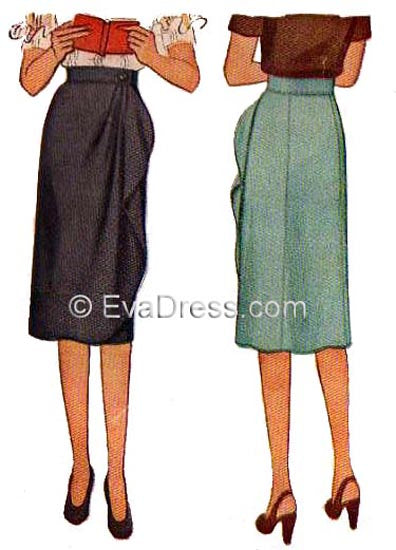


The idea is that the blouse and skirt are soft, sculptured pieces.

As for the color scheme, I am following a palette of colors I enjoyed on Stinson Beach four years ago.  The charcoal of the skirt and the sand of the gabardine both match colors on each end of the mussel shells I picked up from the beach.  I wanted to pull deep blue out of the charcoal woven for some reason (perhaps that seashell's strong influence on me?) so lining it in navy was so suitable.
That said, enter the otherwise 'blue' aspect of the project; the corselet.
I am accessorizing the blouse and skirt with a Tunisian crocheted corselet.  The pattern is from Vogue Knitting, Holiday 2004 (seen here).  To satisfy the competition's requirement of wool content, I chose Madeline Tosh Merino Light for this piece.  The variegated blues in the merino stitched corselet make up the range of blues through the center of the sea shells.
I had made a Tunisian stitched corset in Alchemy's bamboo 8 years ago, only wider than the version I am now doing.  With the large blouse collar and the fact that I am short-waist-ed, I did not want to be engulfed in the wider original version of the stitched corset.

I understand the history of the Tunisian Simple Stitch to be murky, yet the idea of the dense stitch for warm sailor sweaters or Sontag's in the 1800's is clear.  I say this is 'Not your mother's afghan stitch' because as a kid in the 70's, I remember the sunburst-patterned afghan in gold, almond and yellow swathed over couch at any given time.  I like the idea that Tunisian-stitched items started out as very pragmatic, then leaped to one of THE hand stitches in 1970's throws and now has come back as wearable art.
As I like to play on paradox, my concept in the merino-stitched piece dictates what is thought of as a very dense, grid stitch becomes so light and de-materialized is almost ethereal in a very structural corselet!  The wool becomes translucent when crocheted over spiral steel dressmaking bones and the grid stitch pattern opens up when stretched around the midriff.


As in my submission last year, I explored different graphic scales between each piece.  I mentioned how smooth the gabardine blouse is and made a step up to the grainy weave in the Pendleton skirt.  The final transition takes place in the pixilated stitches of the corset, being the piece which separates the blouse and skirt.

More construction details coming up in the next post!

Monday, January 14, 2013

On the Boards This First Quarter of 2013

As I shared from my EvaDress FaceBook, I am re-doing a pattern I had out until a few years ago. It is this German design for a 1929 pin-tucked coat with godets:


The consensus was a range of sizes 32" bust to 46" bust.  That is a range I am currently sizing pattern to presently. This coat will not be out until the second quarter of the year (look for it early summer) although it constitutes a good deal of my present work.

On the boards coming for release through this spring, I have the 1943 Wrap Dress in sizes 32" to 46" bust:

...and another pattern I pulled some years ago as it just didn't sell.

The funny thing, it is one of my favorite first patterns I ever picked up. I created the blouse in a black silk jacquard a few years ago and you will see it in Thread's Magazine Reader's Closet, issue 165 (not the current, but following issue).
So, I opted to throw it out for opinion and based on the feedback I received, I will make this one available near Mid-March also in 32" to 46" bust which has become a standard set of sizes in which I am making patterns.

Among other offerings I have for you this quarter, additional sizes in patterns I issued last year, as promised! Namely, the 1950's blouse and apron.

Much more to come yet, so I will keep all informed.

Friday, August 31, 2012

A Personal Project

I searched YEARS for a similar skirt style made by McCall in the mid-30's:


When I obtained this '29 McCall, I knew I had to put the skirt pieces to use right away!  I need a good skirt to go with a kimono-style top I am finishing from a contemporary McCall's pattern for this Thanksgiving.  I am drawn to how architectural the lines of the skirt are (and funny, I will be dining with architects for that holiday!).
This is the charmeuse print I have:
The skirt will coordinate well in chocolate wool crepe, yuuuuuummmmmmm.

Tuesday, July 24, 2012

1862 German Traveling Dress

Early this year, I joined the Prescott Victorian Society and I have been working on a Civil War era project from this 1862 German Traveling Dress pattern.
Here is a timeline of photos.


I built the hoop skirt some time ago from one of Martha McCain's patterns for Simplicity:
The inside of the dress showing the deep hem facing:
The finished bodice before hooks and eyes concealed by the front facings are applied.  The dress is Indian silk doupioni and the appliqué and covered button contrast is 110 gram silk taffeta:
Shows the finish on the hem with the hem facing and crin in place with the front facing before and after it is turned:

Detail showing one set of appliqués on the skirt and on the sleeve:
The complete dress (sans under collar and under sleeves):
For a little more in depth, I use Pinterest.com as a project montage process where I gather images of inspiration, fabrics swatches, trims, etc. with the patterns I use.

Wednesday, March 7, 2012

That's Sew Cinematic

I spotted this on Debi Fry's blog at Fashions From the Past :


I posted with Rhinestones and Telephones that I wish to take on a project I thought about 10 years ago for a nightgown not unlike what Irene Dunn wore at the end of 'My Favorite Wife'.

It has been a while and I am afraid I did not remember the puff sleeves and that the opening is above the bust line, not below:


Another observation is the slashed opening in the back.


Here is the pattern I found to be very similar (style at upper left, with the opening):


Don't imagine I will commence the project before the end of this month due to heavy deadlines, but I will post my progress to keep you all up to date.

In the meantime, I encourage you all to take a look at this sew-along challenge and participate!

P.S. Here is Cary dressed as Santa, it was too cute not to share here!

Tuesday, November 15, 2011

1930 Leaf Frock in the final stretch!

Have some lining of the flounces to do in order to conceal the white satin organza interfacing:


Waiting for a little more ribbon to arrive so I may finish the straps and add the last layer of leaves to the back panel. Adding that last layer of leaves to the back panel will really give it the volume that the original art portrays and it's a wrap!

Saturday, September 24, 2011

Making the (Leaf Evening Gown) Loop

First of all, when it comes to marking I am a BIG believer in marking via Tailor's Tacks...


The original instructions advise closing the Loop seam and then narrow hemming both Loop edges by hand. However, I narrowed hemmed these edges (by machine, but one could narrow hem at this point by hand as well) and then stitched the Loop closed:


The completed loop (this instruction is also applied to the loop for pattern E30-6719):


If one wishes for more structure to make the top part of the loop more stable, I recommend inserting 1/8" dowels cut to length into the fabric (at the back of the loop) between the top-most pleats.